

Medical College of Wisconsin Precision Medicine Program


A Message from Our Team
Iftikhar J. Kullo, MD - Director, Precision Medicine MS Degree & Certificate Program
 Iftikhar J. Kullo, MD, serves as the Director of the Precision Medicine MS degree and certificate program. He is a Professor of Medicine in the Division of Cardiovascular Medicine, with appointments as Associate Director of both the Mellowes Center for Genomic Sciences and Precision Medicine and the Cardiovascular Research Center at MCW. He also holds a secondary appointment in the Data Science Institute. Before joining MCW, Dr. Kullo spent over two decades at the Mayo Clinic, where he led the Atherosclerosis and Lipid Genomics Laboratory, chaired the Cardiovascular Genomics Task Force, and directed the Early Atherosclerosis and Familial Hypercholesterolemia Clinics. His research on the genetic epidemiology of coronary heart disease and the implementation of polygenic risk scores has been continuously funded by the NIH since 2003, and he has published more than 460 scientific papers.
Precision medicine is redefining how we prevent, diagnose, and treat disease. Advances in genomic sequencing, polygenic risk assessment, and pharmacogenomics now make it possible to move beyond one-size-fits-all care and tailor clinical decisions to individual patients based on their genetic profiles. Our Precision Medicine Master’s program prepares students to lead this transformation — integrating genetic testing, risk stratification, and genotype-guided therapy into real-world clinical practice. Whether you are a clinician seeking to build a genetics program, a researcher aiming to implement genomic discoveries at scale, or a health professional looking to expand your expertise, this program will equip you with the knowledge and skills to make precision medicine a reality for the patients and communities you serve.
Kellie LeGrave, MS, Education Program Coordinator III

Kellie LeGrave, MS, serves as the Education Program Coordinator for the Precision Medicine MS degree and certificate programs, where she is committed to supporting and preparing the next generation of leaders in one of healthcare’s most rapidly evolving fields. She holds a Master of Science in Administrative Leadership in Adult, Continuing, and Higher Education from the University of Wisconsin–Milwaukee and a Bachelor of Arts degree in English from the University of Wisconsin–Madison. With more than 16 years of experience in admissions, student services, and academic program management, Kellie brings both deep expertise and a strong passion for fostering student engagement and success.
Since the program’s launch in 2020, Kellie has played a key role in its growth, helping to cultivate a collaborative, high-quality online learning environment where students can thrive. She is inspired by the potential of precision medicine to transform healthcare through personalized, equitable, and data-driven approaches that center on patient care. Committed to fostering meaningful student experiences and advancing innovative educational initiatives, Kellie empowers learners to make a lasting impact in precision medicine and beyond.
Who Should Join the Precision Medicine Program at MCW?
Why Join the Precision Medicine Program at MCW?
Designed with your schedule in mind, the program offers flexible study options—choose full-time for accelerated completion or part-time to balance your clinical responsibilities, career, and life commitments without interruption.
Things to Know


Learn More About This Exciting Public Health Career
Precision Medicine Program Overview
Admissions Requirements
Requirements: Applicants must hold an undergraduate degree and have completed at least one 3-credit course in genetics or a closely related field from an accredited college or university.
Curriculum and Course Descriptions
The Precision Medicine MS degree is comprised of 30 credits drawn from 3 required and 7 elective courses. The Precision Medicine Certificate is comprised of 12 credits drawn from 1 required and 3 elective courses.
Required for MS degree
PRME 42100 Introduction to Precision Medicine (Fall) 3 credits
Introduction to Precision Medicine offers applied learning sessions led by directors of PM Education courses. Students initiate a professional development plan and write and present reports explaining PM concepts, demonstrating research in practice, and judging the validity of PM information.
*Prerequisites: None; Introduction to Precision Medicine is a prerequisite for all other courses in the PM Ed program.
PRME 42283 Precision Medicine Research Plan (Fall, Spring, Summer) 3 credits
This course requires students to develop a PM research question, to perform a literature review and analysis of the topic, and to create a research plan for IRB submission, if needed. The work is guided by a primary mentor and reviewed by 2 faculty advisors.
*Prerequisites: Introduction to PM
Students must be enrolled in the MS degree program to enroll in the PM Research Plan course. They should complete most if not all of the 7 elective 3-credit PM courses before enrolling in this course.
PRME 42299 Precision Medicine Master’s Thesis (Fall, Spring, Summer) 3 credits
This course requires students to implement a research plan and to write a manuscript discussing the results. The publishable work is guided by a primary mentor and reviewed by 2 faculty advisors.
Prerequisites: Introduction to PM
Students should complete most if not all of the 7 elective 3-credit PM courses before enrolling in this final thesis course. Original observational studies and especially clinical trials may need to be conducted before enrolling in this course due to time constraints. Review papers and commentaries can be written during this course.
Electives
PRME 42185 Cancer Precision Medicine (Fall) 3 credits
This course provides an overview of the molecular basis of cancer, the role of germline and somatic alterations in the development and progression of cancer and the various precision assay methodologies utilized in cancer diagnosis, prognostication and treatment.
*Prerequisite: Introduction to PM
PRME 42170 Medical Genetics, Undiagnosed, and Rare Diseases (Fall) 3 credits
This course allows students to examine the application of genomics to core clinical systems and to apply that knowledge to personalized management of patients. Experts in their respective fields will guest lecture in several sessions.
*Prerequisite: Introduction to PM
PRME 42175 Pharmacogenomics (Spring) 3 credits
This course will give participants a broad perspective on the emergence of clinical and applied pharmacogenomics (PGx) and provide them with insight into its growing importance in major clinical therapeutic areas. Participants will gain an understanding of how genetic differences between individuals can impact the prescription and outcomes of drug therapy. The course will also help participants to understand how individualization of drug therapy based on a person’s genetic makeup can optimize the effectiveness of medications while reducing adverse effects.
*Prerequisite: Introduction to PM
PRME 42155 Epigenomics (Spring) 3 credits
This course is designed to introduce students to Epigenetics and Epigenomics, an important foundation of modern medicine. Epigenomics refers to the inheritance of traits independent of the coding capacity of the DNA and is highly influenced by the environment. In this course, students will discuss molecular mechanisms underlying epigenetic events, the tools for the design and execution of research in this discipline, how to generate and analyze epigenomic data, and the application of Epigenomics to diagnostics, prognostics, and treatments.
*Prerequisite: Introduction to PM
*Recommended: Biomedical and Clinical Informatics and Data Science, Laboratory Genetics and Genomics
PRME 42145 ‘Omics Technology in Precision Medicine (Spring) 3 credits
The ‘Omics Technology in Precision Medicine Course is designed to provide students with a comprehensive understanding of the core laboratory and analytical techniques used in clinical and translational research for the genetic understanding of an individual’s disease. Through a structured exploration of essential concepts in genomics, transcriptomics, bioinformatics, and functional genomics, students will gain exposure and experience with the tools and technologies that drive personalized healthcare advancements. This course is important in that it focuses on the practical and applied aspects of utilizing individual genetic profiles, a rapidly growing field that holds transformative potential for patient care. By understanding the advantages and biases of these laboratory and analytical technologies, students will be prepared to contribute to research and clinical efforts that aim to enhance diagnostic accuracy, improve therapeutic effectiveness, and personalize disease management for diverse populations.
*Prerequisite: Introduction to PM
Elective offered through MCW MSGC Program
GECO 40110 Bioethics in Precision Medicine (Fall) 3 credits
This course will explore the historical, philosophical, rhetorical, and ethical foundations of precision medicine and analyze the bioethical issues raised by this new medical paradigm as they manifest in a variety of clinical, biomedical, and health policy contexts.
*Prerequisite: Introduction to PM
CTSI 20231 Translational Genomics (Spring, in-person) 3 credits
The primary goal of this course is to teach students how to develop a research program to ask relevant genetic questions in the clinical setting utilizing the molecular genetics toolbox. To this end, students will be provided with background in molecular genetics strategies and study designs as well as an understanding of common genetics questions emanating from the clinic so that they will be better able to make connections between bench and bedside. In addition, they will be challenged to think creatively and through a translational focus during course-long case studies and group projects.
*Prerequisite: Introduction to PM
Elective offered through MCW IDP Program
Integrated Microbiology and Immunology (Spring, in-person) 3 credits
The purpose of this course is to introduce basic and integrated concepts in immunology and cellular microbiology through lectures, readings from texts and current journals. The course is geared toward first year students matriculating into the Microbiology and Immunology (MI) Graduate Program as well as any student interested in contemporary concepts of cellular microbiology, immunology, and host-pathogen interactions. The course has been designed to integrate fundamental concepts in immunology and microbiology with the goal of students being able to understand and critically evaluate the complex nature of host-pathogen interactions and immune dysfunction regardless of their specific research focus. Students learn fundamental concepts in immunology and gain an appreciation of the basic properties of bacteria and virus structure, replication, and pathogenesis. In the final block of the course, students integrate their knowledge of pathogens and the immune system.
*Prerequisite: 42100 Introduction to PM
Electives offered through MCW MPH Program:
PUBH 18223 Public Health Policy (Fall) 3 credits
This introductory course will prepare students to know and understand the fundamentals of public health policymaking from the perspective of diverse stakeholders. Throughout the course, students will engage in critical and creative thinking to judge the validity of information and to use defensible and persuasive information to reach new insights in the field of public health policy. Students will be challenged to analyze complex public health policies in areas such as health care reform, health equity, access to care, chronic disease and injury, and global health. This course will assist students in developing the skills necessary to understand and apply diverse sources of information in policy development and the advocacy to implement public health policy.
*Prerequisite: 42100 Introduction to PM
PUBH 18232 Introduction to Population Health Management (Summer) 3 credits
This population health management course engages students to understand, analyze, evaluate, and contribute to population health management. The course includes a textbook and other impactful readings, recorded lectures by expert faculty, and weekly evening Zoom class discussions (or Brightspace or emailed answers to questions). Students write an essay for faculty review and the opportunity to revise and resubmit.
Elective offered through UW-Milwaukee:
HCA-700 Introduction to Health Care Informatics (Fall) 3 credits
An introduction to the history, theory, applications, and organizational context of health informatics.
*Prerequisite: 42100 Introduction to PM
Elective offered through MCW/Marquette University:
BIIN 6931 Topics in Bioinformatics 3 credits
Topics vary. Students may enroll more than once as the subject matter changes.
*Prerequisite: 42100 Introduction to PM
BIIN 17150 Bioinformatics of Systems Biology 3 credits
This course provides the framework for learners to better understand biology using many types of bioinformatics data and analyses. Each data type defines a system that can be analyzed alone or integrated with other layers of data to gain a better contextual understanding of each. Science is typically reductionist, yet Systems Biology is more holistic thinking. Systems biology is a different way of thinking about answering scientific questions. Thus, learners will learn and discuss how bioinformatics and systems biology can be used together to drive research and Precision Medicine. Learners will be instructed in practical aspects of how genomics and epigenomics data is input, stored, searched, analyzed, and interpreted. Finally, ways to integrate among the data layers to solve real biologic questions. We will use information derived from large-scale public datasets; exampled used seek to provide learners with a better understanding of physiology, disease etiology, and more. Learners will complete practical computer lab analyses that are designed to provide the skills needed for a class project that each student will complete, present, and receive feedback on. The learner’s project presentation should summarize the approaches and data used, plus findings or results. In summary, this course will provide skills and concepts for more integrated and holistic thinking about genomics and bioinformatics, oriented towards solving real biologic questions from a systems biology standpoint.
*Prerequisite: 42100 Introduction to PM
Tuition and Fees
If you have questions regarding tuition or your account, please contact the Office of Student Accounts, at (414) 955-8172 or mcwtuition@mcw.edu. Please refer to the All Student Handbook (PDF) for tuition payment policies and information.
Masters, Certificate & Non-Degree Students
Students seeking financial aid for degree programs, please visit the Financial Aid Office website.
Current MCW Employees
Tuition Course Approval Form - Human Resources (PDF)
Late Fees
There is also a $250 late payment fee for tuition not paid on time according to the Tuition Payments policy in the All Student Handbook PDF).
Late payment fee is in addition to any late registration fee.
Financial Aid Questions
For additional information about financial aid, contact the Financial Aid office.
(414) 955-8208 | (414) 955-0119 (fax)
finaid@mcw.edu
Meet Our Students and Faculty
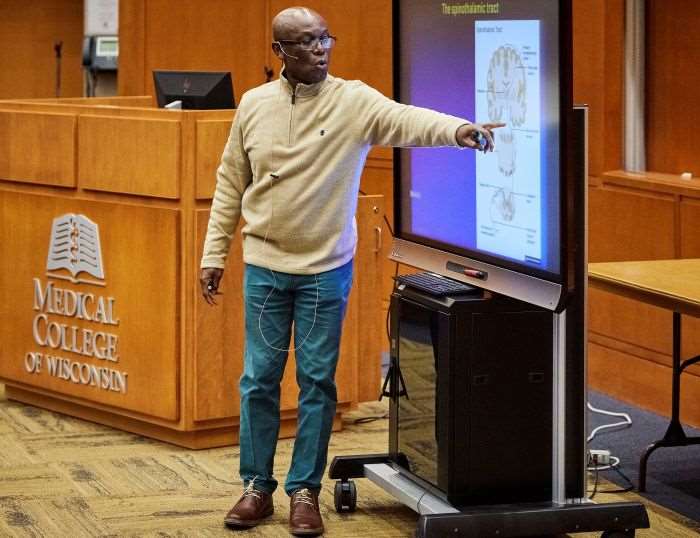
Learn more about the faculty members of the Precision Medicine Program.
Meet the Precision Medicine Faculty


Frequently Asked Questions for the MCW Precision Medicine Program

Academic and Student Services
-
Student Services
Review information regarding financial aid, health and wellness, student inclusion, MCW libraries, and more.
LEARN MORE -
Tuition and Fees
Review financial aid and tuition information by school and program.
Financial Aid -
Academic Consultation
We support student success by assisting with a broad array of student needs and concerns. These include the acclimation to increased academic demand and navigation of institutional policies and requirements.
Get a Consult
Contact the MCW Precision Medicine Program
We are excited to answer your questions and to discuss how the program might meet your professional development needs.
